You Don't Need a CLM Tool
Here's what to use instead if you're under 150 people.
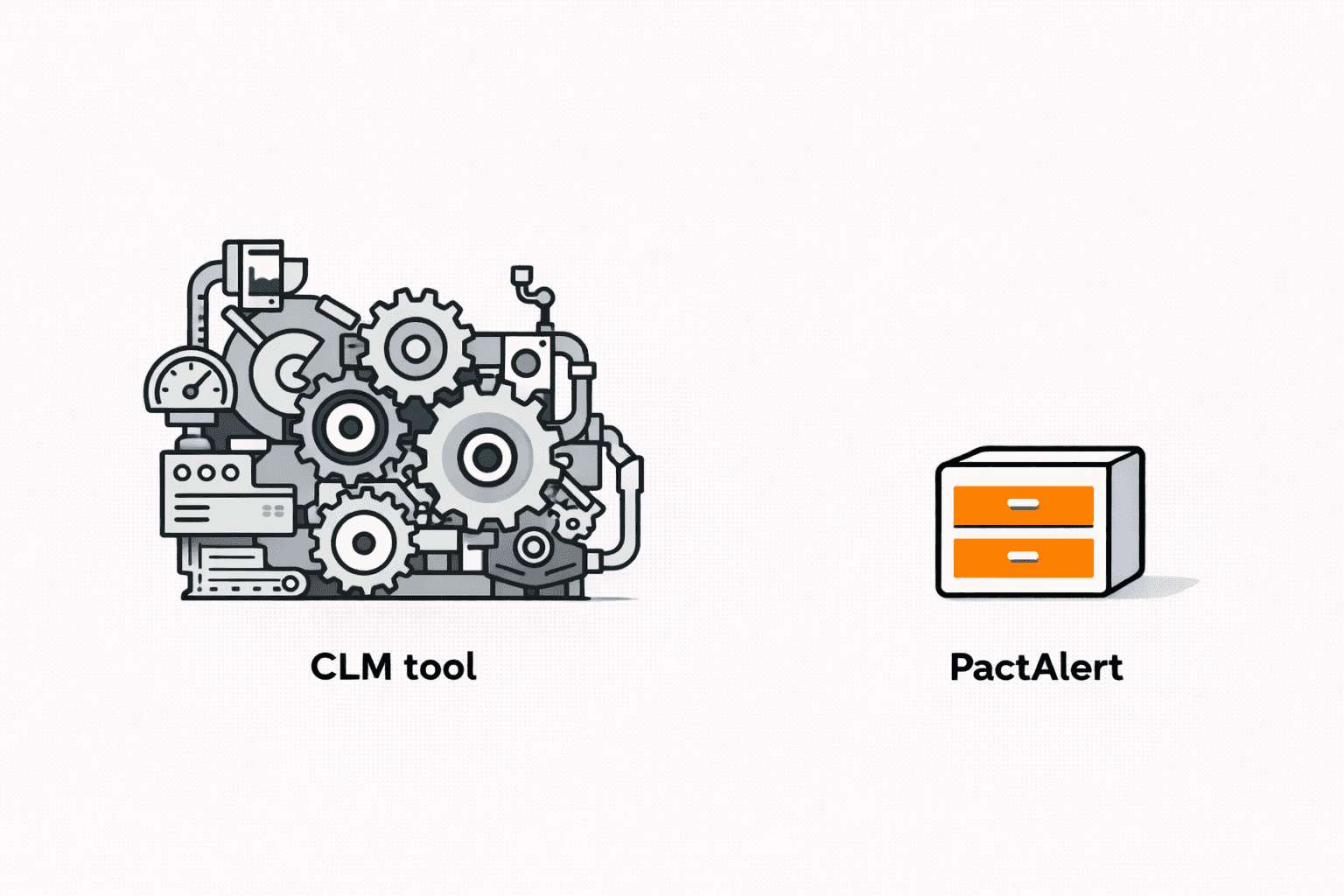
Search "contract management software" and every result will try to sell you a CLM platform. Contract Lifecycle Management. The enterprise solution. The "complete" answer.
Here's the thing nobody in the CLM industry wants to admit: if you're a 50-person company, you probably don't need 80% of what these tools do. You're paying for features built for legal teams at Fortune 500 companies. And you're paying a lot.
of first-time CLM implementations fail to deliver expected benefits
Source: Gartner
of small businesses fail with overly complex contract management systems
Source: RenewalScout
This guide will walk you through what CLM actually is, what it actually costs, why most of it doesn't apply to growing companies, and what to use instead. Fair warning: this is a contrarian take. If you're a CLM vendor, you won't like it.
What CLM Actually Is
Let's be fair first. CLM - Contract Lifecycle Management - is a real category that solves real problems. For the right companies.
The "lifecycle" in CLM refers to every stage a contract goes through:
Request
Drafting
Negotiation
Approval
Execution
Management
Renewal
Termination
A full CLM platform handles all of this. That means:
- Contract templates - Pre-approved language for common agreements
- Clause libraries - Standardized clauses legal teams can mix and match
- Redlining tools - Track changes, compare versions, negotiate terms
- Approval workflows - Route contracts through the right people in the right order
- E-signatures - Built-in signing or integration with DocuSign/Adobe
- Repository - Central storage with search and organization
- Reporting - Dashboards showing contract status, value, risk
- Obligation tracking - Post-signature deadline and task management
Who is this built for? Legal teams at companies with 500+ employees. Teams managing hundreds or thousands of contracts. Companies that draft contracts, not just sign them.
What CLM Actually Costs
CLM vendors love "Contact Sales" buttons. Here's what you'll actually pay:
| Platform | Annual Cost | Notes |
|---|---|---|
| Ironclad | $60K - $150K+ | Enterprise leader, Gartner Magic Quadrant |
| Agiloft | $6K - $60K | Flexible but complex pricing |
| Juro | $5K - $34K | Modern UX, browser-based editor |
| Concord | $6K - $8K | Transparent pricing, 5 users included |
| ContractSafe | $4.5K - $9K | Repository-focused, unlimited users |
| DocuSign CLM | Custom ($$$$) | Separate from eSign, enterprise only |
And that's just the software. Add:
- +Implementation: 3-6 months average for enterprise CLM
- +Dedicated admin: Someone has to run this thing
- +Training: Getting legal, sales, ops all using it
- +Change management: Convincing people to stop using email
- +Ongoing maintenance: Updates, support tickets, workflow tweaks
For a 50-person company, you're looking at $6K-$60K/year in software, plus months of setup, for a tool built for companies 10x your size.
Why 80% of CLM Features Don't Apply to You
Here's the uncomfortable truth for CLM vendors: most growing companies don't need most CLM features.
You probably don't DRAFT contracts
Think about it. How many contracts does your company actually write from scratch? Most of your contracts are vendor contracts that come TO you. Their legal team wrote them. You just sign. Templates and clause libraries? Useless if you're not the one drafting.
You don't need REDLINING
Enterprise legal teams redline contracts clause-by-clause. But when a 50-person startup signs a SaaS contract with Salesforce, Salesforce's legal team isn't negotiating individual terms with you. You're signing their standard agreement. The power dynamic doesn't support redlining.
You don't need APPROVAL WORKFLOWS
At a 500-person company, a $50K contract might need sign-off from legal, finance, the department head, and a VP. At a 50-person company? The founder says "yes" in Slack. You don't need a 5-step approval workflow. You need someone to make a decision.
You don't need E-SIGNATURE (built in)
You already have DocuSign. Or HelloSign. Or PandaDoc. Paying extra for e-signature inside a CLM when you're already paying for a standalone e-sign tool? That's double-paying for the same thing.
You don't need a CLAUSE LIBRARY
Clause libraries are for legal teams that draft dozens of contracts a week and need standardized language. You're not a law firm. You're a startup. You sign maybe 5 contracts a month, and most of them are vendor agreements someone else wrote.
For most companies under 150 people, the actual needs are simple:
- 1. Know what you signed
- 2. Track what you owe
- 3. Act before deadlines
That's stage 6 of 8 in the CLM lifecycle. You're paying for 8 stages when you need 1.
The Post-Signature Problem
Here's the irony: CLMs are built for everything before you sign. Drafting. Negotiating. Approving. Signing.
But what happens after you sign? The contract goes into a repository. Maybe you get a renewal reminder. And then... that's it.
The obligations in that contract - the things you're required to do - live in a PDF. Meanwhile, your actual work happens in Jira. Or Notion. Or Trello. There's no bridge.
I looked at 50+ contract management tools during competitive research. Not one pushes tasks directly to Jira, Notion, or Trello. Not one extracts obligations and turns them into assignable work items. The CLM industry built everything around lawyers creating contracts. They forgot about ops teams managing them.
This is why 9% of revenue gets lost to poor contract management. Not because people don't have CLM software. Because obligations stay trapped in signed PDFs while work happens somewhere else entirely.
What to Use Instead
Here's the lightweight stack that actually works for growing companies:
Contract Storage
Google Drive (you already have it)
E-Signatures
DocuSign or HelloSign (you already have it)
Obligation Tracking + Task Creation
PactAlert
Task Management
Jira, Notion, or Trello (you already have it)
Full CLM
$6K - $100K/yr
3-6 months implementation
Lightweight Stack
$500 - $1,700/yr
5 minutes to start
The lightweight stack isn't a downgrade. It's right-sized. You're using tools you already know, adding obligation tracking where you actually need it, and skipping the 80% of CLM features that don't apply to you.
Want to start for free? Try our free Contract Tracker tool. It calculates notice deadlines, color-codes urgency, and exports to your calendar. No signup, no cost, data stays in your browser.
When You Actually DO Need a CLM
I'm not saying CLMs are bad. They're built for specific use cases. Here's when you should actually get one:
Get a CLM if you:
- Draft 50+ contracts per month (not sign - draft)
- Have a dedicated legal team (not just "the founder reads contracts")
- Need complex approval workflows with multiple stakeholders
- Are at 500+ employees
- Operate in highly regulated industries (healthcare, finance, government)
- Need audit trails and compliance reporting for regulators
If 3+ of those apply to you, yes, look at Juro, Concord, or Ironclad. You're the target customer. The investment makes sense.
Skip the CLM if you:
- Mostly sign contracts written by vendors
- Have <150 employees
- Don't have a legal team
- Approval is "the CEO says yes in Slack"
- Your main problem is tracking obligations, not drafting contracts
The Bottom Line
The CLM market is growing fast - from $1.26B in 2024 to nearly $4B by 2032. That growth is real. Enterprises need this software.
But "enterprises need it" doesn't mean you need it. If you're a 30-person startup being sold a $40K CLM platform, someone's making a lot of commission off you.
The question isn't "which CLM should I buy?" It's "do I need a CLM at all?" For most companies under 150 people, the answer is no. You need contract storage (Google Drive), e-signatures (DocuSign), and obligation tracking that connects to where you actually work (PactAlert).
That's a $500-$1,700/year problem. Not a $40,000/year problem.
Need obligation tracking without the CLM overhead?
PactAlert extracts obligations from contracts and creates tasks in Jira, Notion, or Trello. No 6-month implementation. No dedicated admin.
Join the Waitlist