The Hidden Costs of SaaS Nobody Talks About
Your subscription price is just the tip of the iceberg.
You sign up for a tool at $50/month. Reasonable. A year later, it's $57. Then $65. Then $75. Nobody warned you about this. The pricing page still shows $50.
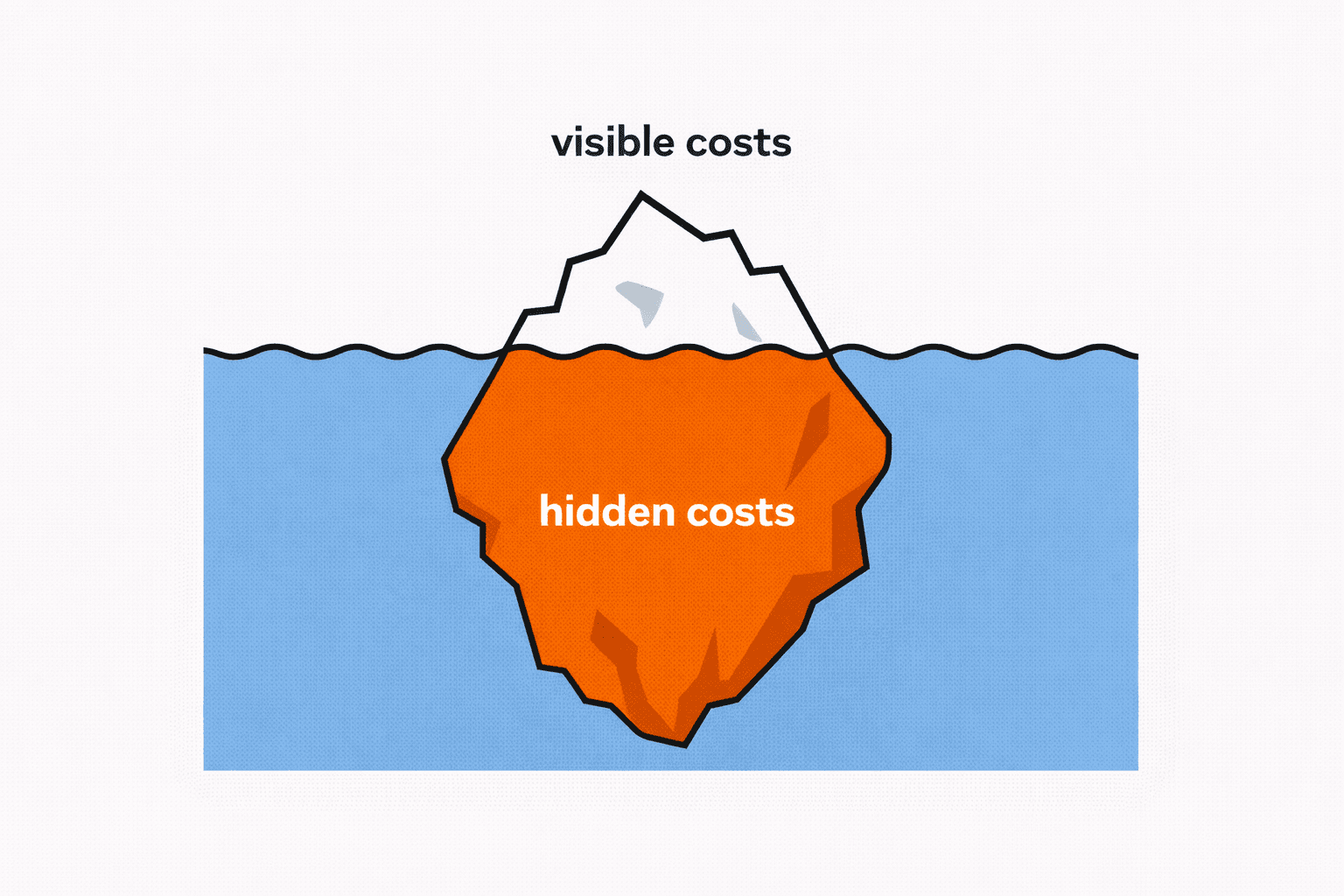
That visible subscription price? It's the tip of the iceberg. Below the waterline sits the real cost: automatic price increases, unused licenses bleeding money, implementation time nobody budgeted for, and the eventual pain of switching away.
SaaS vendors don't advertise these costs. Why would they? But if you want to actually understand what software costs your business, you need to see the whole iceberg.
Hidden Cost #1: The Annual Price Increase
Here's a number you won't find on any pricing page: 12.2%. That's the average annual SaaS price inflation according to Vertice's 2024 research. Not inflation-adjusted pricing. Actual price increases, year over year.
average annual SaaS price inflation
Source: Vertice SaaS Inflation Index 2024
At renewal time, expect increases between 10-15%. Some vendors push for 25% or more. And because most contracts auto-renew, these increases happen whether you agree or not.
The math: A $1,000/month tool at 12% annual increases becomes $1,762/month after five years. You're paying 76% more for the same thing.
The worst part? These increases happen automatically. If you're not tracking your notice periods, you've already agreed to the new price before you even saw it.
5-Year Cost: $1,000/month Tool
Hidden Cost #2: Licenses Nobody Uses
You buy 20 seats. Three people actually use it regularly. Another five log in occasionally. The other twelve? They forgot the password months ago.
This isn't a worst-case scenario. It's the average. According to Zylo's research, 51% of SaaS licenses go unused. More than half.
of SaaS licenses unused
avg annual waste per organization
The typical culprits:
- •Licenses for employees who left (but nobody canceled)
- •Tools bought for a project that ended
- •Two apps that do the same thing (marketing bought one, sales bought another)
- •"We might need it someday" licenses
For a 50-person company spending $200K/year on SaaS, that's roughly $100K in waste. Every year.
Hidden Cost #3: Implementation and Training
The pricing page says $99/month. It doesn't mention the 40 hours your team will spend setting it up. Or the week of reduced productivity while everyone learns the interface.
This is real cost, even if it never shows up on an invoice:
True Cost Example: $99/month CRM
That $99/month tool actually cost you $307/month in year one. The subscription was only 32% of the real cost.
Hidden Cost #4: The Exit Tax
Getting in is easy. Getting out is expensive. Vendors know this.
You've been using a project management tool for two years. It's gotten expensive, and something better exists. Simple switch, right?
Not quite:
- •Export your data (if they even let you)
- •Convert formats to work with the new tool
- •Rebuild integrations with other systems
- •Retrain everyone on the new interface
- •Lose productivity during the transition
- •Pay for both tools during the overlap period
This "exit tax" is why people accept 15% price increases instead of switching. The switching cost often exceeds a full year of subscription. Vendors are banking on this.
- • Proprietary data formats (can't export to standard formats)
- • No API access on lower tiers
- • History/data only exportable as PDF (not structured data)
- • "Contact us" for data export requests
- • Multi-year contract required for reasonable pricing
Hidden Cost #5: The Feature Tax
You signed up for a basic plan. Works fine. Then they move features to higher tiers. Reporting that used to be included? Now it's "Pro only." Integrations? "Business tier and above."
Your price didn't increase. Your plan just got worse.
This is harder to track than a price increase. You're still paying the same amount. But the value you're getting shrinks over time. Eventually you're forced to upgrade or find workarounds.
Adding It All Up
Let's put together a realistic 3-year cost for that $1,000/month tool:
3-Year Total Cost of Ownership
That's 68% more than the sticker price. And we haven't even included the eventual cost of switching away.
How to See the Whole Iceberg
You can't eliminate these costs entirely. But you can stop being surprised by them.
1. Read the renewal terms before you sign
Look for: auto-renewal clauses, price increase caps (or lack thereof), notice period requirements. If there's no cap on increases, assume 10-15% per year.
2. Track notice periods, not renewal dates
The renewal date doesn't matter if you've already missed the notice window. Track when you need to act, not when the contract ends. More on this here.
3. Audit licenses quarterly
Set a calendar reminder. Check actual usage against paid seats. Cancel or downgrade anything with less than 50% utilization. Use our 60-minute audit checklist.
4. Budget for the real cost, not the sticker
When evaluating new tools, multiply the subscription by 1.5-2x to estimate true Year 1 cost. Factor in implementation time at your team's hourly rate.
5. Test data portability before you commit
Before signing an annual contract, verify you can export your data in a useful format. If you can't test it yourself, ask for documentation. No clear export path = high exit tax.
The Real Lesson
SaaS pricing is designed to look simple. Monthly fee, clear tiers, no surprises. But that simplicity hides a lot. The companies that control their software costs aren't the ones who find the cheapest tools — they're the ones who see the full picture before the invoice arrives.
Stop the surprise renewals
PactAlert extracts notice periods from your contracts and alerts you before auto-renewal. See the iceberg before you hit it.
Join the Waitlist