AI Contract Review Software for Agencies: 22 Tools Tested, 0 Built for You (2026)
Four lanes. 22+ tools. Real pricing ($288K Harvey → $99 Spellbook). The agency gap nobody mentions.
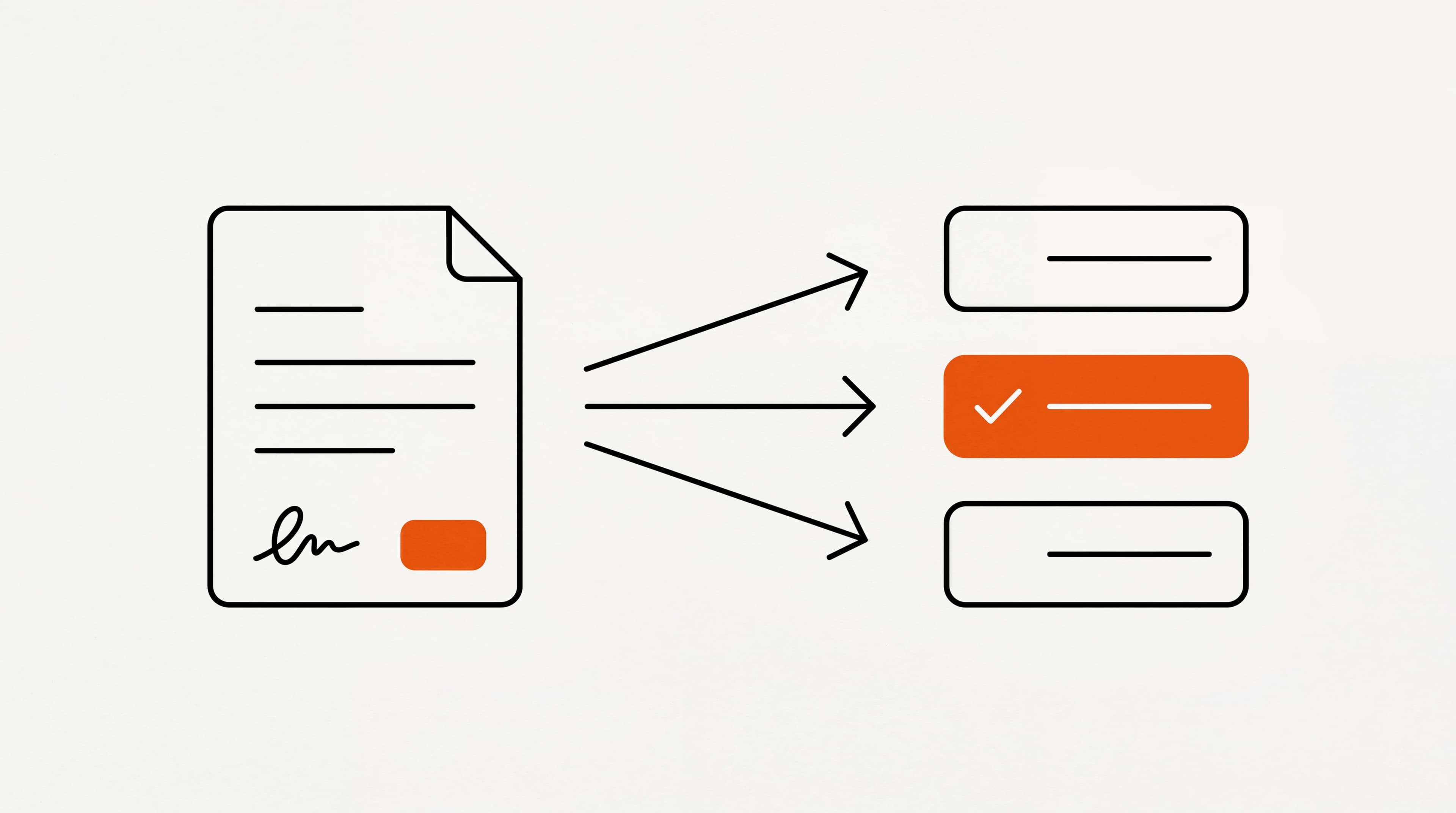
Search "AI contract review software" and you get back fifteen vendor pages, twelve listicles, and exactly zero clarity.
We thought this comparison would take an afternoon. Three days later, we had 22 vendor tabs open, four spreadsheets of leaked pricing, and a working theory: the category had quietly split into four different products that all share a name.
That's the problem. "AI contract review" means at least four different things. Vendors know this. Vendors don't care. They write "AI-powered contract review" on every page and let you figure out what they actually do.
Here's what they actually do, what they cost, and the question every comparison post avoids: which one is built for agencies?
The four lanes of "AI contract review"
Disambiguate first. Compare second. Most articles don't. We will.
Pre-signature drafting and redlining
AI sits inside Microsoft Word and helps lawyers draft, redline, and negotiate clauses. You feed it a draft; it suggests cleaner language, flags deviations from your playbook, and spits out alternative phrasings.
Tools: Spellbook, Harvey AI, Loio, Definely.
Buyer: a transactional lawyer or in-house counsel actively negotiating an agreement. Workflow happens in Word. If you don't open Word to draft contracts, this lane is not for you.
Pre-signature risk review against a playbook
An inbound contract arrives. AI checks it against your company's pre-built playbook (must-have clauses, deal-breakers, position fallbacks) and flags problems before a human lawyer sees it.
Tools: LawGeex, LegalSifter, DocJuris, Diligen, LegalOn.
Buyer: in-house legal team trying to scale review of inbound contracts (NDAs, vendor agreements, sales paper) without adding headcount.
Post-signature obligation extraction
The contract is already signed. AI reads it and pulls the things you actually have to do. Deadlines, deliverables, milestones, notice periods, renewal dates, SLAs. Then turns them into trackable tasks somewhere a human will actually see.
Tools: Lexion (now part of DocuSign IAM), Evisort (now Workday), Agiloft, LinkSquares, DocuSign CLM. Pactalert sits here.
Buyer: legal ops, procurement, finance. Or, and this is where the gap opens, operations leaders at agencies who already have signed client contracts and just don't want to miss anything in them.
Document Q&A / chat-with-contract
You upload a PDF. You ask it questions. "When does this auto-renew?" It tells you.
Honestly? ChatGPT and Claude do this for free now. Paxton AI and Kira (now Litera) still exist as specialty options for larger workflows, but if your use case is ad-hoc questions about a single document, the tools you already pay for probably suffice. This whole lane is being commoditized in real time.
Why disambiguating matters
Buying a Lane 1 tool when you needed Lane 3 means paying for redlining you'll never use, while the deadlines you actually missed stay buried in the same PDFs. Lane confusion is the #1 reason CLM purchases get sold internally as "AI contract review" and then quietly fail at adoption.
Pricing reality: from $99 to $288K
Three orders of magnitude. Same category name.
Public pricing is rare in this market. Numbers below come from vendor sites where they're published, plus pricing aggregators (Hyperstart, Aivortex, Eesel) that compile sales-disclosed quotes.
| Tool | Lane | Annual cost (USD) |
|---|---|---|
| Harvey AI (mid-market) | 1 + 4 | $288K–$360K entry (20-seat min) |
| Ironclad (enterprise) | 1 + 3 | $200K+, plus $50K–$100K implementation |
| Ironclad (mid-market) | 1 + 3 | $50K–$120K |
| ContractPodAi (Leah) | 1 + 3 | ~$75K (estimated) |
| Agiloft | 3 | ~$60K (estimated) |
| DocuSign CLM | 1 + 3 | ~$50K (estimated) |
| LinkSquares | 3 | $10K–$75K (seat-priced $2.5K–$3.5K/user) |
| SpotDraft | 1 + 3 | $5K–$50K+ (VerifAI add-on $5K–$15K) |
| Concord | 1 + 3 | $5,988 (5 users) + $588/user |
| Spellbook (Enterprise) | 1 | $4,200/user (6-mo min) |
| Spellbook (Professional) | 1 | $1,788/user/yr |
| Spellbook (Starter) | 1 | $1,188/user/yr |
| Loio (Business) | 1 | $708/user/yr |
| Pactalert (founding) | 3 | $180–$780/yr |
Sources: Hyperstart pricing analyses, Aivortex Spellbook/Harvey AI breakdowns, Eesel AI Harvey pricing guide, Concord pricing page. Acquisition figures from GeekWire, Workday IR, TechCrunch.
The missing middle.
Below this band, you get freelancer suites (HoneyBook, Bonsai, Dubsado at $16–21/mo) that create contracts but don't extract obligations from them. Above this band, every tool starts at "contact sales." In the middle: a real gap.
The category just consolidated. The SMB band got abandoned.
If you started shopping for AI contract review in 2023, the tools you'd have considered are mostly gone now. Or they belong to someone bigger.
- →Lexion → DocuSign, $165M (May 2024). The Seattle-based AI contract management company is now part of DocuSign IAM.
- →Evisort → Workday (September 2024). Estimated $250–300M based on $155M raised pre-acquisition. Now a "document intelligence" feature inside Workday.
- →Robin AI collapsed (October 2025–January 2026). $10M ARR wasn't enough; HMRC filed a winding-up petition; managed services went to Scissero, the engineering team got acqui-hired into Microsoft Word.
- →Kira Systems → Litera (2021). Kira's contract analysis tech now lives inside Litera's transaction-management suite.
- →Agiloft launched Obligation Management (December 2025) as "the AI-native era of contract lifecycle management." Enterprise flag-planted on Lane 3.
- →Spellbook raised $40M debt for acquisitions (March 2026), explicitly to consolidate the legal-AI category further.
- →Harvey AI: $11B valuation (March 2026), up from $3B fourteen months earlier. Seat pricing climbed to $1,200–$2,000/user/month.
The pattern: independent AI contract review companies are either getting absorbed by enterprise platforms (DocuSign, Workday, Microsoft) or going up-market. Nobody's coming down to serve the agency-and-services-firm tier.
That matters because the consolidated incumbents inherited their original price floors. DocuSign IAM doesn't suddenly cost $50/month because it now contains Lexion. Workday Document Intelligence isn't getting a freelancer tier.
One thing every vendor underplays: AI contract review tools hallucinate
Vendors lead with accuracy claims. The numbers are usually true. The conditions usually aren't.
The most-cited figure in the category is LawGeex's 2018 NDA study: AI scored 94% accuracy, lawyers scored 85%, AI took 26 seconds, lawyers took 92 minutes. That study is eight years old, NDA-only, and pre-LLM. It still gets cited weekly.
More recent and more honest: a 2024 Stanford HAI study tested legal-AI research tools and found Westlaw AI hallucinated on 33% of queries; Lexis+ AI on 17%. That's legal research, not contract review specifically. But the pattern generalizes: vendors ship, vendors over-claim, and the independent benchmark always finds the cracks.
Pull-quote from a real LinkSquares review
"When importing contracts, the accuracy was uneven. Around 30% of contracts had incorrect or missing renewal terms. Signature date extraction was hit or miss. Only ~50% were correctly identified."
— Volody review of LinkSquares CLM (2025).
Translation: even at $10K–$75K/year, expect to spot-check the AI's output. "AI extracts your obligations" is not the same thing as "your obligations are now correct." A tool that lets you verify and edit the extraction beats one that hides it.
The agency gap: 0 of 22
We researched 22+ tools in this category. Read every homepage, every customer-logos band, every "who we're built for" page. Here's the count of tools that name agencies, design studios, dev shops, marketing/PR firms, or consultancies as their lead ICP:
out of 22 tools researched
Every AI contract review tool we found targets one of:
- •A lawyer. Spellbook, Harvey, Loio, Paxton, LawGeex. Customer logos: Vinson & Elkins, A&O Shearman, Dentons, Reed Smith.
- •A corporate legal-ops or in-house counsel team. Ironclad, LinkSquares, ContractPodAi, Sirion. Customer logos: Mastercard, L'Oréal, Cisco, Shell, OpenAI.
- •A procurement or finance team. Klarity, Sastrify. Customer logos: Deloitte, Zoom, Genesys.
- •A "fast-growing team," pitched at a startup's first legal hire. SpotDraft.
None lead with: "you are an agency whose contract is the work, your ops lead is the buyer, your tooling stack is Jira and Notion and ClickUp, and you need to extract obligations from signed client contracts so nobody misses a milestone."
Adjacent agency tools exist. HoneyBook, Dubsado, Bonsai, Scoro, Ignition. They generate contracts, run proposals, and bill clients. None of them read signed PDFs and turn them into trackable tasks. That's a different problem with a different shape.
Honest recommendations by use case
No tool is best in general. There's a best one for a specific arrival state.
You're a lawyer drafting contracts in Word every day
Spellbook ($99–$350/user/month) for solo or small-firm lawyers. Harvey AI ($1,200+/user/month, 20-seat minimum) if you're at an AmLaw 100 firm with the budget. Both Lane 1.
You're an in-house legal team scaling NDA / vendor review
LawGeex or LegalSifter for playbook-based pre-signature risk review. Ironclad if you're large enough to also need a full CLM and have $50K+ budget. Lane 2 + 3.
You're an enterprise looking for full CLM with AI features
DocuSign IAM (post-Lexion), Workday Document Intelligence (post-Evisort), Agiloft, SirionLabs. Budget $50K–$200K+/year, plus 6-month implementations. All Lane 1 + 3.
You're an agency with signed client contracts you keep missing things in
None of the above are built for you. Pactalert sits in Lane 3 specifically for agencies, dev shops, design studios, and consultancies. Upload your signed MSA or SOW; obligations land as tasks in Jira, Notion, ClickUp, Asana, or Trello. Pricing band: $15–$65/month, not $5K–$200K/year.
Three things to do before you buy anything
Pick a lane. Are you negotiating contracts (Lane 1), screening inbound contracts (Lane 2), tracking obligations in signed contracts (Lane 3), or asking questions about a single document (Lane 4)? You can't shop intelligently until you've named the workflow.
Get the price in writing before the demo. If a vendor refuses, that tells you the price. The transparency gap in this category is real. Spellbook's Trustpilot reviews complain about it explicitly. Walk if they won't commit.
Test extraction accuracy on your own contracts. Not on the demo PDF. Take three real signed agreements with non-trivial structure, run them through, and verify the deadlines, notice periods, and renewal dates by hand. If the tool gets >30% wrong (LinkSquares user benchmark), you have your answer.
Watch what Spellbook does with the $40M acquisition fund it raised in March. Watch where Workday takes Evisort once the integration finishes. Watch whether Agiloft's December 2025 obligation-management launch picks up any customer below the Fortune 1000.
The pattern says the tools surviving the next 18 months will mostly serve enterprise. Agencies that signed a contract last week and missed a milestone yesterday won't be on anyone's roadmap. So we built one for them.
Tracking obligations in signed client contracts?
Pactalert is Lane 3 for agencies. Upload an MSA or SOW; deadlines, deliverables, and notice periods land in Jira, Notion, ClickUp, or Asana. Founding price $15/mo.
Join the Waitlist