8 Real Scope Creep Examples from Reddit (And the Contract Clause That Would Have Stopped Each)
Eight verbatim stories from r/agency, r/freelance, and r/Entrepreneur. Permalinks included.
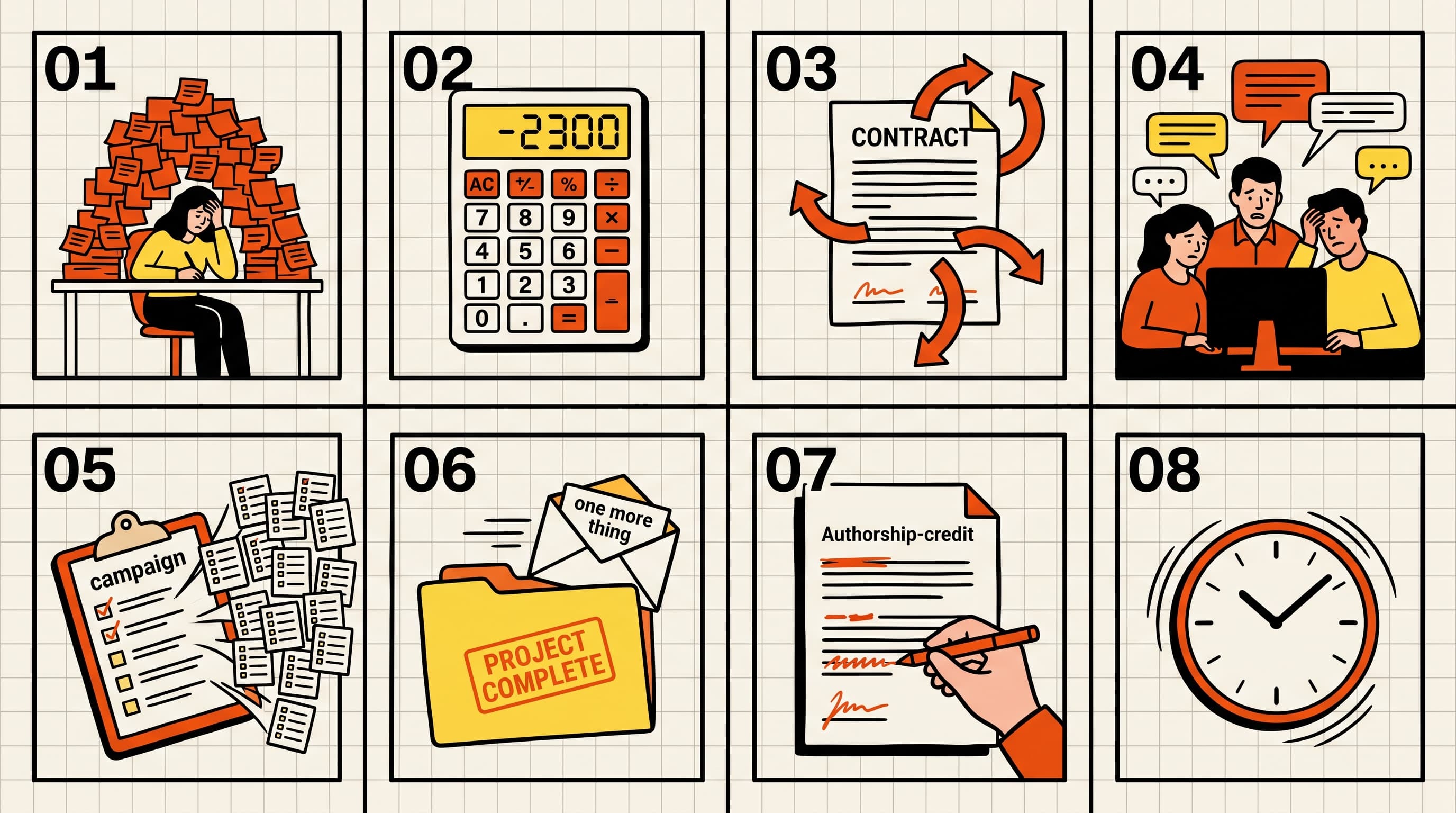
Most articles about scope creep explain it in the abstract. We'd rather show you eight specific moments where it happened to specific people, in their own words, on Reddit — then point at the exact contract clause that would have stopped each one.
We pulled these from r/agency, r/freelance, r/digital_marketing, and r/Entrepreneur across roughly the last 18 months. Permalinks at the bottom of each story so you can read the original. The numbers are operator-reported, the bruises are real, and the patterns repeat enough that you'll likely recognize at least one as something that's already happened to you.
Background context, if you're cold to this: 87% of agencies lose at least $1,000 a month on unbilled scope work, and only 1% bill clients for all of it (Ignition's 2025 State of Agency Pricing & Cash Flow report, 273 respondents). The 1% number is the one that matters — it says scope creep isn't a few badly-run shops, it's structural.
We wrote a fuller prevention guide last week, over here. This article is its companion: a gallery of what scope creep actually looks like in the wild, plus the clause that fixes each pattern.
How to read this
Each story has the same shape: what happened (the original Reddit post or comment, lightly trimmed), where their contract failed them (the structural gap), and the clause that would have stopped it (verbatim language you can copy into your next SOW). Clauses sourced from ContractNerds, Law Insider, Ken Yarmosh, Drew McLellan, and Ironclad. Receipts at the end of each section.
01.The $2,300 landing page
r/freelance · u/Able_Juggernaut_149 · 64 upvotes
A freelancer takes a $2,000 landing-page job at $100/hr, scoped at 20 hours. The work happens. Then the client follow-ups start. "Can you add a blog section?" +10 hours. "Actually let's change the entire color scheme." +8 hours. "One more revision on the copy." +5 hours.
"Final tally: 43 hours worked, $2,000 paid. That's $2,300 in unpaid work (23 hours × my $100/hr rate). I kept saying yes because I didn't want to lose the client or get a bad review."
There was a contract here, with the $2,000 fee written in. So this isn't a story about a missing contract. It's a story about a contract that didn't name a revision count or distinguish "in scope" work from "additional" work. Every request landed in a gray zone where the freelancer could have pushed back but didn't.
The clause that would have stopped it
Revision-rounds cap with named overage rate
"Revision requests beyond the 3 included rounds will be billed at $X per hour with a minimum of X hours, subject to our availability. A change order will be issued before any additional work begins."
Source: Ken Yarmosh, "How to Write a Scope of Work." Drew McLellan's named-fee variant: "With this estimate, you are going to be granted four revisions. Any revision after the fourth will result in a $250 fee."
Original thread: reddit.com/r/freelance/lost_2300_to_scope_creep
02.The "small favors" avalanche
r/agency · u/its_akhil_mishra · 22 upvotes (cross-posted)
An agency owner running IT projects writes about a pattern they call "small favors." The post hit the front page of r/agency twice. The thesis:
"The biggest problem in IT projects isn't missed deadlines or bad code; it's the endless stream of 'small changes' that appears once the work is nearly finished. It starts innocently — a client asks for a tiny tweak, you say yes to keep goodwill, and before you know it those tiny tweaks multiply until the project never really ends. Every unpaid revision you accept resets expectations and moves the goalposts for what the client believes is included."
The structural failure: their SOW listed what was in scope but didn't list what was out. So every "small favor" lived in a definitional gap — neither explicitly included nor explicitly excluded — and the team defaulted to including it.
The clause that would have stopped it
Out-of-scope catch-all
"Any work not set forth in the scope of work section is out-of-scope work and will require a change order to be performed. For the avoidance of doubt, the following work is out-of-scope and will require a change order to be performed: [list 4–8 specific items the team commonly gets asked for]."
Source: ContractNerds, "Best Practices for Drafting a Statement of Work Template." The trick is the second sentence: naming specific common requests as out-of-scope. It removes the "but I thought that was included" conversation entirely.
Original thread: reddit.com/r/agency/small_favors_can_eat_your_margins
03.The two-week designer burnout
r/agency · u/Fayezbahm · 30 upvotes
Agency onboards a new client. The first deliverable goes through 5–6 rounds of revisions. The designers crack. The client leaves anyway.
"We onboarded a new client, but the designs weren't up to standard and went through 5-6 rounds of revisions. The designers were breaking down under the pressure, and the client left within two weeks of onboarding."
What's notable about this one: scope creep didn't just kill the margin. It killed the relationship the agency was bending over backward to protect. Saying yes was supposed to be the "keep them happy" move. It wasn't.
Same root cause as Story 01 (no revision cap), but a different lesson. A team forced to deliver round 6 of work it never agreed to is a team that ships worse work, and the client notices. So the revision cap protects margin and quality at the same time. Most articles only frame it as a margin tool. The quality angle is why your designers will thank you for adding it.
The clause that would have stopped it
Revision-rounds cap (paired with definition of a "round")
"The fee includes up to two (2) rounds of consolidated revisions per deliverable. A 'round' means a single set of feedback delivered as one document or call, not feedback delivered in multiple emails over multiple days. Revisions beyond the included rounds, or feedback delivered piecemeal, will be billed at $X per hour subject to a written change order."
Source: synthesized from Drew McLellan (Agency Management Institute) and Ken Yarmosh. The piecemeal-feedback clause is the one most agencies skip, and it's the one that would have caught Fayezbahm's scenario. "5–6 rounds" usually means 30 separate emails treated as a single "round" by the client.
Original thread: reddit.com/r/agency/whats_the_worst_way_youve_ever_lost_a_client
04.The creator-marketing trap
r/digital_marketing · u/eren_yeager04
An agency runs influencer campaigns for six clients. They run the numbers and find they're losing money on two and barely breaking even on most of the rest:
"Main issue is scope creep we didn't anticipate. Client signs on for 'influencer campaign management' which sounds straightforward but then it becomes content rights negotiation, crisis management when a creator posts something off brand, explaining to legal why we can't get every creator to sign a 40 page contract, chasing down tax forms, dealing with product shipping logistics…"
This is a different shape than Stories 01–03. The work didn't expand because the client added requests; the work expanded because the SOW was vague enough that every adjacent task was implicitly included. "Campaign management" means twelve different things to twelve different people. By week three, the agency was effectively running a creator-relations agency, a legal review desk, and a logistics outfit, all for the price of a campaign manager.
The clause that would have stopped it
Out-of-scope catch-all + named exclusions
"The Services do not include, and any work in the following categories will be treated as out-of-scope and require a separate change order: (a) negotiation or drafting of creator contracts beyond Agency's standard one-page release; (b) crisis communications or PR response to creator content; (c) tax form collection or 1099 preparation; (d) shipping logistics, returns, or warehousing of physical product; (e) legal review of creator-generated content."
Source: pattern from ContractNerds combined with the Law Insider "Major Modifications" clause library. The fix isn't adding hours to the SOW. The fix is making the boundary visible.
Original thread: reddit.com/r/digital_marketing/why_were_losing_money_on_creator_marketing
05.The freelancer who actually triggered the clause
r/freelance · u/Outside-Paramedic793 · 16 upvotes
This is the rare counter-example: someone whose contract clause actually saved them. We're including it because every gallery of failures needs at least one example of what working looks like.
A copywriter is booked for a 7-asset project. The kickoff arrives. The brief is barely defined. The project leads scramble to prep, and they start asking the writer to help prep the project itself, which wasn't in the original scope. The deadlines have already been promised to their client. The writer's clock is ticking the whole time.
"My contract states that if the brief or delivery dates change, I can revisit my quote. I triggered that clause and gave them two options: 1. Accept my new (inflated) quote 2. Replace me with another copywriter."
What's instructive here isn't the dollar amount. It's that the clause was a mechanism, not a statement of intent. It said specifically what counted as a brief change, what would happen when one occurred, and how the writer would respond. When the moment came, there was no "let me see what I can do." There was a procedure.
The clause that worked
Brief-change re-quote trigger
"If the project brief, deliverable list, or delivery dates change after this agreement is signed, [Provider] reserves the right to revisit and revise the quoted fee. Any revised quote must be approved in writing by [Client] before further work continues. If the revised quote is not accepted within 5 business days, either party may terminate this agreement and [Provider] will be paid for work completed to date."
Source: practitioner pattern, common across UK-based freelance contract templates. The 5-business-days timeout is the load-bearing detail — without it, "revisit" turns into "perpetually pending."
Original thread: reddit.com/r/freelance/trying_to_get_out_of_hellish_contract
06.The post-sign-off phantom project
r/Entrepreneur · u/Pale_Pipe9196 · 220 upvotes
A web designer ships a 6-week ecommerce build, the client approves everything, the final invoice is paid. Project closed. Then:
"Since then ive gotten probably 8 emails asking for quick changes or one small adjustment that would only take a few minutes. First it was changing some button colors. Then it was adding a new section to the homepage. Then it was reworking the entire navigation menu because they had a better idea. Each time I politely remind them that the project is complete and any additional work would require a new contract or hourly rate. The thing is, these small changes add up. Ive probably spent another 4-5 hours total on these requests because I feel guilty saying no."
This is the most dangerous shape of scope creep, and the most ignored. The contract said the project was done. The invoice was paid. There's no "in-progress" SOW to point to. The only thing keeping the work going is the absence of a written rule that says "done is done."
The clause that would have stopped it
Deemed-acceptance + post-acceptance work clause
"Client shall have ten (10) business days from delivery of each deliverable to provide written acceptance or specific written rejection. Failure to respond within this period shall constitute acceptance. After acceptance, any further work — including but not limited to revisions, additions, or modifications to accepted deliverables — shall be quoted as a new project at then-current rates, with a minimum engagement of [X] hours, and shall require a new signed agreement before work begins."
Source: Ironclad CLM "What Is an SOW" clause library, plus practitioner extension. The minimum-engagement-hours line is what stops "just five minutes" requests from compounding. Make the floor 4 hours and a lot of post-completion creep evaporates on its own.
Original thread: reddit.com/r/Entrepreneur/how_to_politely_tell_a_client
07.The yes-to-everything trap
r/agency · u/Davetechlee · 10 upvotes
An agency owner reflecting on how they lost a client early in their career. The post wasn't about the loss — it was about why their team was working overtime for months before the loss happened:
"We landed a client who was enthusiastic and full of ideas. The problem was, the ideas never stopped. Every check-in call resulted in a 'quick little addition' or a 'small tweak' to the scope. I was young and inexperienced, so I didn't know how to draw boundaries. I just kept saying 'yes,' thinking that was the best way to keep the client happy. The result was that my team and I were constantly working overtime, chasing a finish line that kept moving."
The thing the author didn't have wasn't a process. They could have written down "say no to small additions" on a Post-It and it wouldn't have helped. What was missing was a tool that forced the conversation. A change-order requirement, signed every time, even at $0, is that tool. It moves the "say no" moment from a verbal exchange (where people-pleasers fold) to a paper exchange (where the rule is the rule).
The clause that would have stopped it
Change-order-required (with $0 enforcement)
"Any change to the scope of work — including additions, deletions, or modifications, regardless of size or fee — requires a written and signed change order before [Provider] performs the changed work. Change orders may carry zero fee where appropriate, but the signature is required. Verbal approvals, Slack messages, and email confirmations alone do not constitute a signed change order."
Source: Jason Swenk's "$0 change order" method, formalized into clause language. Karl Sakas calls the trigger question "Would you like an estimate for that?" Same idea, different vocabulary: every request hits the change-order pipe, even if the pipe is empty.
Original thread: reddit.com/r/agency/whats_the_worst_way_youve_ever_lost_a_client (different comment, same thread as Story 03)
08.The retroactive redefinition
r/freelance · u/Good-Writer1551 · 30 upvotes
Engineering freelancer takes a project: seat design plus partial ergonomic validation. Authorship on a future paper offered as bonus incentive. Then mid-project, the client's asks expand — find values from papers, make engineering judgments, fix dimensions, travel to other institutes, use other workstations. They decline. Project wraps. Then:
"When I asked to close the project and receive payment, the narrative shifted: the work was reframed as 'design only,' authorship was suddenly 'reconsidered,' and I felt implicitly blamed for not doing more — despite the new requests being outside the original scope."
This is the worst kind of scope creep: the kind where the definition of the work gets rewritten in retrospect. Without a frozen scope record — written, dated, signed — the freelancer loses the argument by default. The client's memory of the SOW becomes the SOW.
The clause that would have stopped it
Major-modifications protection (the "frozen scope" clause)
"The Parties recognize that the design and development efforts described in a SOW might need to be revised over time. Absent written approval from the Parties, no change(s) that would substantially impact costs, functionality, scope of work, or milestone schedules (collectively 'Major Modifications') shall be made to any SOW. The signed SOW remains the binding statement of work; verbal or email proposals to expand or contract the SOW shall not be enforceable unless executed as a written change order."
Source: Law Insider clause library, "SOW Change Orders and Project Reviews," re-used across 30+ public agreements. The second sentence is the one that protects against retroactive redefinition. Without it, a determined client can argue the SOW "evolved" through the email chain.
Original thread: reddit.com/r/freelance/freelanced_on_an_academic_simulation_project
The pattern across all eight
Every story above has the same structural failure: the contract clause that would have stopped the bleeding either didn't exist or wasn't enforceable in the moment. The agency or freelancer was checking work against memory, not against a document. The fix is to make the document checkable in real time — by a person if you're small, by a tool if you're scaling.
The 5-minute audit
Pull up your last three signed SOWs. Run them through these five questions. If you can't point at a specific clause that answers each question, you have a gap of the kind every story above describes.
How many revision rounds are included?
If the SOW says "reasonable revisions" or doesn't mention a number, you have Story 01's problem. The number doesn't need to be small. It needs to exist.
Is there a list of work that's explicitly out of scope?
Stories 02 and 04 happened because the SOW only listed in-scope work. Out-of-scope is the load-bearing list. That's where the "but I thought that was included" conversation gets pre-emptively settled.
Does "done" have a written definition?
Story 06 happened because the contract didn't name what acceptance looked like or how long the client had to do it. A deemed-acceptance window (10 business days is industry standard) ends the project even if the client never says "yes."
What happens if the brief changes mid-project?
Story 05's freelancer had a re-quote clause. Most contracts don't. If yours doesn't name what counts as a brief change and what triggers when one happens, your only recourse is hoping the client behaves.
Is there a change-order requirement that survives Slack and email?
Story 07 happened because every "quick tweak" got verbal approval and slipped into the work. Story 08 happened because email-thread "agreements" got reinterpreted later. The clause that fixes both is one line: "Verbal and email approvals do not constitute a signed change order."
If you ran those five questions on three SOWs and got fewer than 12 yes-answers across them, your standard SOW template is leaking margin. Fix the template, not the next contract — every contract you sign with the leaky template costs you somewhere between Story 01's scale and Story 04's.
The harder version of the same fix
Tightening the SOW template handles future contracts. It does nothing for the 15–50 active engagements you already have signed.
The agencies that solve scope creep at scale don't just write better SOWs — they make the existing SOW visible at the moment a request comes in. When a client asks for the fourth revision and the contract caps revisions at three, somebody on the agency side needs to know that, in the moment, without rereading a 14-page PDF.
That's the lane Pactalert is building in. Upload your signed SOWs; we extract every scope-defining clause (revision caps, change-order triggers, acceptance windows, kill-fee schedules, brief-change clauses) and surface each as a tracked rule in Jira, Notion, ClickUp, or Asana. The next time someone on your team is about to say yes to a fourth revision, the system says: this is round 4. The contract caps at 3. Issue a change order before continuing. The decision moves from memory to mechanism.
For the full prevention guide (six places scope creep starts, the PM-tool gap audit, the practitioner playbook from Karl Sakas, Drew McLellan, and Jason Swenk), read the companion piece: How to Prevent Scope Creep at Your Agency.
For an honest comparison of the AI tools that promise to do this kind of contract work for you (most don't, and we'll tell you why): AI Contract Review Software for Agencies — 22 Tools Tested.
Stop checking SOWs from memory.
Pactalert extracts every scope clause (revision caps, change-order triggers, acceptance windows) from your signed SOWs and turns each into a tracked rule in Jira, Notion, ClickUp, or Asana. Founding price $15/mo.
Join the Waitlist