5 Best Proposify Alternatives for Agencies (2026): What Each One Does Well, Plus the Post-Signature Gap
PandaDoc, Better Proposals, Qwilr, HoneyBook, and Bonsai — by use case, with real pricing. And what every proposal tool stops doing the moment the client signs.
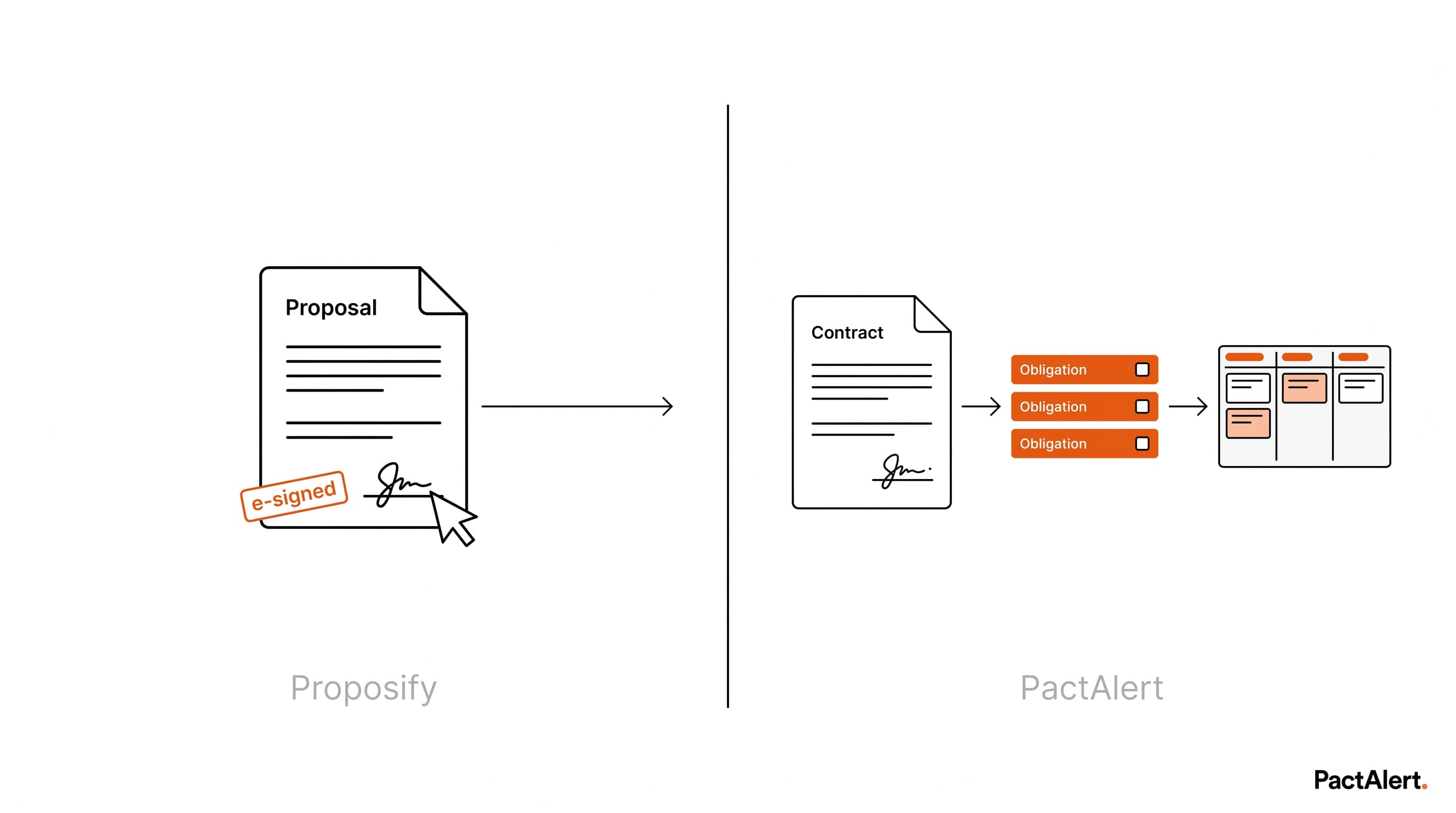
Proposify is a solid proposal tool. If you're shopping alternatives, you probably have one of three reasons: the per-seat price stopped making sense at scale, the templates feel constraining, or you realized the actual pain is what happens after a proposal gets signed. The tool doesn't solve any of that, and neither do most of its competitors.
This is an honest comparison of five Proposify alternatives ranked by use case, with real 2026 pricing. We use Proposify and a few of these tools at PactAlert, and we'll be straight about what each one does well versus where you'll outgrow it. At the end we'll cover the gap none of them fill, which is also the lane we work in.
Skip to the 60-second decision matrix if you already know what you're looking for.
What Proposify is actually good at
Worth saying out loud, because you'll see a lot of comparison posts that pretend the incumbent is a disaster. It's not.
- →Templates and branding. The template library is the reason most agencies pick Proposify in the first place. Visual quality is consistently high without needing a designer to set every proposal up.
- →Pipeline visibility. The proposal-stage dashboard shows what's in draft, sent, viewed, and signed — useful for sales handoffs at small-to-medium agencies.
- →Approval workflows. Multi-step internal review before a proposal goes to the client. Most direct competitors require workarounds for this.
- →E-signature inside the same tool. No DocuSign handoff for most cases.
If those four things are 90% of your proposal workflow and the price is fine, you don't need an alternative. Save yourself the migration effort.
Why agencies actually switch
Three patterns show up in r/agency threads and our own conversations with operators:
1. Per-seat pricing at scale
Proposify is $35–65 per user per month billed annually. At 5 seats that's ~$3,000/year. At 15 seats, $11,700. Several alternatives below charge flat-rate (per-account, not per-seat), which crosses over for any team of 4+ people.
2. Limited integrations into the ops stack
Proposify connects to HubSpot, Salesforce, Zapier, and a few others. If you live in ClickUp, Notion, Productive.io, or Scoro for delivery work, the proposal data sits in a silo. Some teams want CRM-native pricing/quoting (PandaDoc's area). Others want a proposal that's just a web page (Qwilr's area).
3. The post-signature wall
This is the underrated reason. Your team signs the proposal, the contract goes to PDF, and from that moment Proposify is done. The deliverables list, the revision-rounds cap, the milestone schedule, the kill-fee triggers — all of that becomes invisible to your project tracker. We wrote about this gap in detail here. None of the five alternatives below solves it either.
The five Proposify alternatives, ranked by who they fit
We picked these five because each one is the right answer for a specific kind of agency, not because they all do the same thing slightly differently. The decision criterion is what kind of work you do, not which tool has the longest feature list.
01.PandaDoc
Best for: B2B agencies living inside HubSpot or Salesforce
Pricing
Free plan available (e-sign + basic docs). Essentials $19/user/mo, Business $49, Enterprise custom. Annual billing required for paid tiers.
Strongest claim
Deepest integrations of any tool in this category. HubSpot, Salesforce, Pipedrive, Zoho — quote-to-cash flows happen inside the CRM, not in a separate app.
Where it beats Proposify: the integrations and the free plan. If you're running a sales team out of HubSpot or Salesforce and want quotes to live where deals live, PandaDoc is the pragmatic switch. The CPQ-style features (line-item pricing, configurable products) are also stronger.
Where Proposify is better: visual templates and brand customization. PandaDoc proposals look more like sales documents, less like art-directed pitches. If your agency sells creative work and the proposal is part of the sale, this matters.
Verdict: straightforward switch for B2B-shaped agencies. Skip if you sell on aesthetics.
02.Better Proposals
Best for: design-led agencies that hate per-seat pricing
Pricing
Starter $19/mo flat (not per-user). Premium $39, Enterprise $59. Includes unlimited users on every tier.
Strongest claim
Templates that actually look designed, not Bootstrap-generated. The detail-level analytics on what clients hover over and skip is genuinely useful for proposal optimization.
Where it beats Proposify: the math. Five seats on Better Proposals Premium = $468/year flat. Five seats on Proposify = ~$3,000/year. For a small-to-mid agency, the difference is one part-time hire.
Where Proposify is better: internal approvals and team workflow at larger headcounts. Better Proposals is built around "one person sends a proposal," not "four people review before it goes out." If you have a serious approval chain, you'll feel the gap.
Verdict: the obvious switch for design studios and freelancers under 10 people. Less obvious for agencies with formal review workflows.
03.Qwilr
Best for: agencies whose proposals should feel like landing pages
Pricing
Business $35/user/mo, Enterprise $59/user/mo, both annual. Free 14-day trial; no permanent free tier.
Strongest claim
Proposals are responsive web pages, not PDFs. Embed video, interactive pricing tables, calculators, scroll animations. Clients open a URL, not a 23-page PDF.
Where it beats Proposify: the medium itself. A Qwilr proposal feels modern in a way a Proposify PDF doesn't. If your client is going to open this on their phone in a coffee shop, that matters. The interactive pricing (toggle line items, see total update) shifts conversations toward decisions.
Where Proposify is better: when the client wants a PDF for legal review or board signoff. Qwilr can export to PDF but the result is a flat representation of an interactive document. Some industries genuinely need the PDF as the artifact, not as a fallback.
Verdict: the right answer for digital agencies, marketing agencies, and SaaS-services companies whose buyers are millennials or younger. Wrong for industries where the PDF is still the legal document.
04.HoneyBook
Best for: creative agencies and solo studios that want everything in one tool
Pricing
Starter $19/mo, Essentials $39/mo, Premium $79/mo. Up to 1, 2, or unlimited team members depending on tier. Annual billing discount available.
Strongest claim
Proposals + contracts + invoices + payments + client communication + scheduling, all in one place. Built specifically for service businesses (photographers, designers, consultants).
Where it beats Proposify: scope. Proposify handles proposals; HoneyBook handles the entire client lifecycle from inquiry to final payment. For a solo creative or two-person studio, that consolidation is worth the trade-offs.
Where Proposify is better: proposal-specific features. HoneyBook's proposal builder is fine, not exceptional. If proposals are 60% of how you sell and the visual quality of the proposal is part of the sale, you'll feel HoneyBook's ceiling. Also: HoneyBook is best in the U.S. — international payment support is more limited than Proposify or PandaDoc.
Verdict: the right answer if you're consolidating four tools into one. Wrong if proposals are your differentiator and you need them to be perfect.
05.Bonsai (HelloBonsai)
Best for: solo consultants and small freelance teams
Pricing
Starter $17/mo, Professional $32/mo, Business $66/mo. Annual billing discount available. Built for one user; team add-ons cost extra.
Strongest claim
Designed for self-employed operators. Proposals + contracts + time tracking + invoicing + tax estimates in a single low-friction tool that doesn't require you to be an admin.
Where it beats Proposify: economics for one-person shops. Proposify's bottom tier assumes a team; Bonsai assumes you. The 1099 / tax-estimate features are unique among proposal tools.
Where Proposify is better: any team larger than 3 people. Bonsai's collaboration features are a workaround, not a feature.
Verdict: if you're a freelancer or 1–2 person shop, Bonsai is honestly the better tool. If you're an agency, you'll outgrow it within a year and have to migrate.
Side-by-side at a glance
| Tool | Entry price | Pricing model | Sweet-spot agency |
|---|---|---|---|
| Proposify | $35/user/mo | Per-seat, annual | Mid-size, brand-led |
| PandaDoc | Free / $19/user/mo | Per-seat, free tier | B2B, CRM-native |
| Better Proposals | $19/mo flat | Flat, unlimited users | Design-led under 10 |
| Qwilr | $35/user/mo | Per-seat, annual | Modern digital agencies |
| HoneyBook | $19/mo | Tiered, all-in-one | Solo + 2-person creative |
| Bonsai | $17/mo | Tiered, freelance-shaped | Solo / 1–2 freelancers |
The thing all six tools share
Every tool above (Proposify included) does the same thing in the same window: build the proposal, get it signed, store the PDF. Their job ends at signature. From that moment on, the deliverables list, the revision cap, the milestone dates, the notice period, the kill-fee schedule — all of it lives in a PDF nobody opens, while the actual project work moves to ClickUp or Notion or Asana.
What Proposify (and every alternative above) doesn't do
We talked to operators in r/agency threads about contract management and the pattern is consistent. Quote from a top thread asking "What contract management software do you use for your agency?":
"Top mentions: HelloBonsai, Proposify, Better Proposals, HoneyBook, PandaDoc, Concord. Notably, none of them extract obligations — they are all create / sign / store contracts."
That's the post-signature wall in plain language. Six tools, one shared blind spot. When a client asks for the fourth revision and your SOW caps revisions at three, no proposal tool will tell you. When a 60-day notice period elapses and the retainer auto-renews on a stale rate card, no proposal tool will flag it. When a milestone payment was supposed to trigger and didn't, no proposal tool will catch it.
That's the gap PactAlert lives in. Upload your signed proposals — from any of these tools, or from DocuSign or PandaDoc directly — and we extract every obligation (deliverables, milestone dates, revision caps, notice periods, kill-fee triggers, acceptance windows) and turn each one into a tracked rule in Jira, Notion, ClickUp, or Asana. The next time a client asks for a fourth revision, the system already knows the contract caps it at three.
We're not a Proposify alternative. We're what an agency should pair with whichever proposal tool they pick. Read the longer argument here, or see what 8 real Reddit scope-creep stories look like and which contract clauses would have stopped them here.
The 60-second decision matrix
→ Stay on Proposify if
Templates and brand consistency are 80% of the value. Your team is 3–10 people. Per-seat math still works.
→ Switch to PandaDoc if
You sell B2B, live in HubSpot or Salesforce, and want quotes inside the CRM.
→ Switch to Better Proposals if
You're design-led, under 10 people, and the per-seat pricing finally hurts.
→ Switch to Qwilr if
Your buyers are digital-native and a web-page proposal will close better than a PDF.
→ Switch to HoneyBook if
You're a creative studio consolidating four tools into one and the all-in-one trade-off makes sense.
→ Switch to Bonsai if
You're a solo consultant or 1–2 person freelance team and want one tool for proposals, contracts, and invoicing.
→ Add PactAlert alongside any of these if
Your real pain is what happens after the proposal is signed: missed revisions, slipped milestones, blown notice periods, scope creep. We don't replace your proposal tool. We pick up where it stops.
One last note. If you're comparison-shopping proposal tools because the deeper pain is post-signature, you'll save yourself a migration by reading our scope-creep prevention guide first. Sometimes the answer is "keep Proposify and add a layer" rather than "switch tools and hope it gets better."
For the broader picture of where AI contract tools fit (and which ones are honestly not for agencies), see our companion piece: AI Contract Review Software for Agencies — 22 Tools Tested.
Already picked your proposal tool? Pair it with what comes next.
PactAlert extracts every obligation from your signed proposals (deliverables, revision caps, milestones, notice periods) and turns each into a tracked rule in Jira, Notion, ClickUp, or Asana. Founding price $15/mo.
Join the Waitlist